 English
 Árabe
Árabe
 Español
 Русский
 日本語
日本語
 한국어
한국어
 Dansk
Dansk
 Nederlands
 Italiano
 Português
 Türkçe
 Deutsch
 Français
 Prancis
 ไทย
ไทย
 Tiếng Việt
 हिंदी
हिंदी
 বাংলা
বাংলা

Shandong gains new momentum: A project to produce 2,000 tons of water-based ink annually has been launched, further deepening its presence in the water-based ink market.
Recently, Shandong Forste New Material Technology Co., Ltd. 's 2,000-ton-per-year water-based ink project completed its environmental impact assessment and officially entered the construction phase, adding new momentum to Shandong's green printing industry. As a specialized and innovative enterprise focusing on the research and development and production innovation of gravure printing water-based ink technology, the launch of this new production capacity is not only an important milestone in Forste New Material's own development, but will also promote the improvement and upgrading of the water-based printing industry chain in northern China, injecting strong impetus into the green transformation of downstream industries such as packaging and decorative materials.
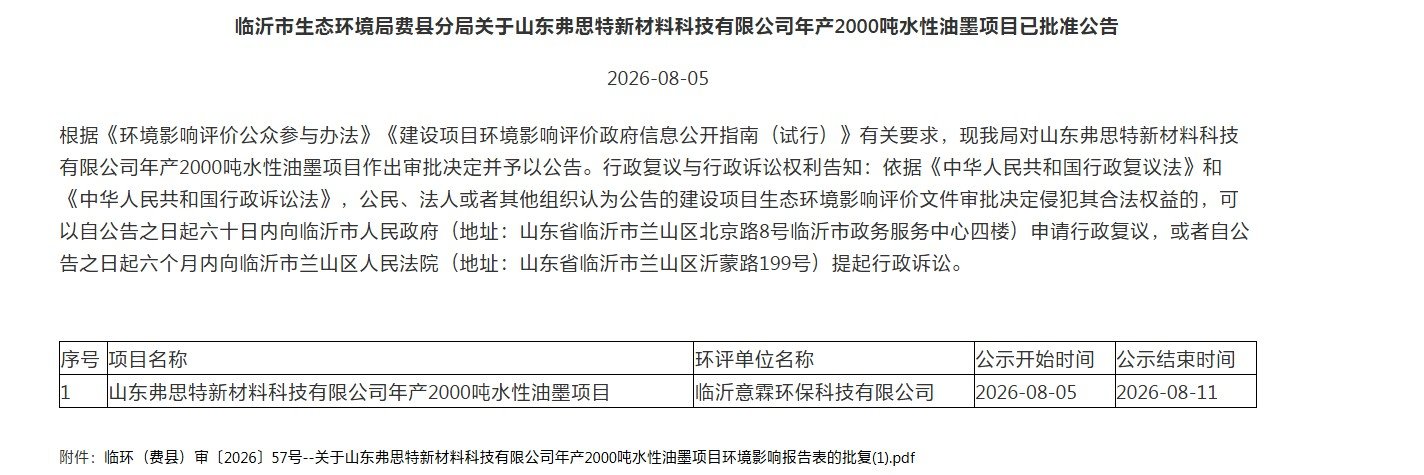
Founded in 2021, Forste New Materials has established two major production bases in Linyi, Shandong and Laibin, Guangxi , with a total building area of approximately 6,000 square meters. The company currently employs 20 people, 40% of whom hold bachelor's degrees or higher. The core R&D team possesses years of technical expertise in the ink industry. Prior to the launch of this new 2,000-ton project, the company already had an annual production capacity of 5,000 tons of water-based inks for decorative paper and PVC . Its products are widely applicable to various applications, including flexible PVC, rigid PVC flooring films, and decorative paper. With their high-temperature resistance, colorfastness, vibrant colors, and strong adhesion, they have gained recognition from numerous downstream customers.
Distribution and Development of Water-Based Inks in Shandong
Overall, Shandong's water-based ink industry has formed a regional distribution pattern with Linyi as the core and Qingdao and Jinan as important supports. Relying on the supporting needs of downstream printing and home decoration industries in various regions, it has gradually built a green water-based ink industry cluster in northern China.
Linyi City
It is currently the core cluster area of Shandong's water-based ink industry . A representative project is the 2,000-ton-per-year water-based ink project of Fuste New Materials located in Tanyi Town, Feixian County. Relying on the downstream demand of the local decorative paper and board industry cluster, it has formed a complete industrial ecosystem from raw material matching to end application, and is an important production base for gravure water-based ink in northern China.
Qingdao
With Jimo District as the core layout point , the water-based ink and varnish project newly announced in August 2026 was located in Daxin Street. Relying on the strong demand of the packaging and printing industry around Qingdao, it focuses on the layout of flexographic and gravure water-based inks and supporting water-based varnishes, and is the core supply area of water-based inks in Jiaodong Peninsula.
Jinan City
The industry is relatively concentrated , with existing water-based ink related enterprises mainly located in Licheng District and High-tech Zone, each accounting for 50%. The representative enterprise is Jinan Apollo Cultural Products Co., Ltd., which focuses on water-based ink products for cultural and creative industries and printing support, and is an important industrial hub in central Shandong.
Over the next three years, Shandong's water-based ink market will leverage the environmentally friendly replacement demand for "oil-to-water" solutions from downstream industries such as decorative paper and food packaging, coupled with the synergistic advantages of the upstream water-based polyurethane and other raw materials. Through the upgrading of high-end specialty ink products and the gradual release of new production capacity, it will open up incremental space in the green printing sector in North China and gradually build a leading water-based ink industry cluster in northern China.
Meeting Introduction